

How One-Point Design Build Stops the Blame Game?
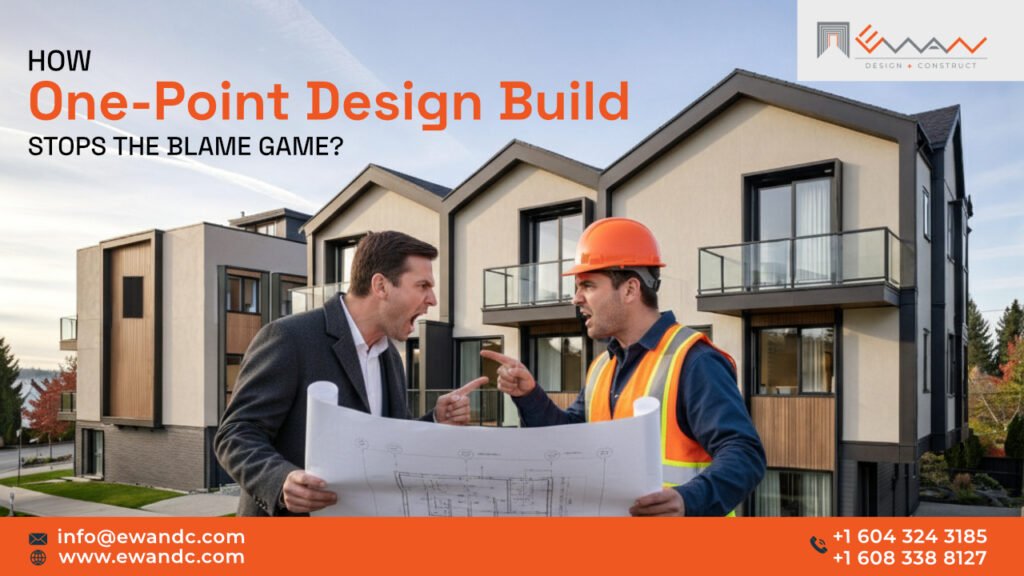
To understand why design build construction is the secret sauce of residential construction and renovations, just picture this:
It’s minus five outside, you’ve got a double-double in hand. You just stopped by your job site, hoping to see the framing going up. Instead, you walk into a face-off that’s more aggressive than a third-period hockey game.
The architect is claiming the builder ignored the drawings. The builder is looking at the architect like they’ve been hit one too many times with a puck. Caught in the middle is you—the homeowner—just trying to get your reno done before the snow flies.
It’s the classic construction “Blame Game.” It’s stressful. It burns through your loonies faster than a cottage weekend, and frankly. It’s about as welcome as a blackfly in May.
But there’s a better way, eh? One-Point Design-Build is a sensible approach. This puts everyone on the same team, ensuring the only thing getting iced is the champagne at the finish line. Here is how this method stops the finger-pointing and gets the job done right.
Why does the Traditional Architect–Builder Blame Game Happen?
In the traditional world of real estate development, most folks start by hiring an architect at first. Then bidding the plans out to building companies or contractors. It sounds sensible. But it often ends up being a recipe for a “he-said, she-said” gong show due to missing key steps.
The architect wants to win awards for a West Coast Modern masterpiece, while the builder is looking at the actual cost of lumber and the reality of digging a foundation in a rocky soil or peat bog area.
When the quotes come in at double the budget, or a window detail doesn’t hold up against Canadian winters, or the architectural details are too complex, the finger-pointing starts. The architect blames the builder’s “lack of vision,” and the builder blames the architect’s “impossible and impractical drawings.”
Why this Blame Game Happen So Often?
Split Loyalties: Both parties are looking out for their own separate contracts rather than a common goal.
Budget Gap: Architects often design “pretty pictures” without checking current local material costs and fixing details.
Sequential Planning: Problems aren’t spotted until the hammer hits the nail, at which point fixing them costs a fortune.
Essentially, you’re the referee in a game where both players are on different teams. It’s stressful, it’s expensive, and frankly, it’s not how a proper project should run.
One-Stop-Shop: Pulling Design and Construction in the Same Direction
If you’ve ever tried to paddle a canoe with someone who isn’t in sync, you know you’ll just end up spinning in circles near the dock. Hiring a unified Design and Build company is about getting everyone’s paddles in the water at the same time. By bringing the designers, engineers, and trades under one roof, you eliminate the friction that usually slows projects down.
In a design-build model, the designer and the builder are on the same side of the table from day one. They share a single goal: delivering your home on time and on budget to your vision. There’s no incentive to hide behind a contract or throw someone else under the bus because, at the end of the day, they are the same company.
The benefits of this unified approach include:
Shared Liability: If there is a mistake, the team fixes it internally without billing you for “consultation hours” to figure out who messed up.
Consistent Values: Everyone is aligned on BC building code, Step Code, Accessibility requirements, and sustainability goals from the start.
Team Spirit: The carpenter knows the designer by name, and they’ve likely worked on ten other houses together. That trust is worth its weight in gold.
It’s a “we’re all in this together” mindset that makes the construction process feel less like a battle and more like a collaborative effort.
How Progressive Design Build Actually Makes Sense on the Site?
Out here on the coast, we deal with tricky terrain, strict municipal bylaws, and weather that can change in a heartbeat. Progressive Design Build is the most logical way to handle these variables. Instead of finishing a 100-page set of drawings and hoping for the best, your design-build contractor provides “constructability” feedback while the design is still being sketched out.
This means before you get your heart set on a massive floor-to-ceiling glass wall, the builder is there to say, “That’s beautiful, but it’ll require a crane we can’t fit down this Kitsilano alleyway with intersecting powerlines.”
This real-world reality check saves you from the heartbreak of paying for plans you can’t actually build. Whether you are doing a new custom home or a complex renovation, having the “street smarts” of a builder involved early keeps the project grounded in reality.
How this makes sense for your Vancouver site:
Early Cost Certainty: You get a realistic “Price to Build” much earlier than in the traditional model.
Weather Mitigation: Construction schedules are designed around our rainy season by the people who actually have to work in it.
Bylaw Navigating: The in-house registered professionals collaborate to ensure the design meets Vancouver’s complex zoning and permit requirements without requiring constant revisions.
It’s about being “street smart” with your architecture. You get a home that looks like a million bucks but is built with the efficiency of a well-oiled machine.
Your One Point of Contact: No More Middleman
Perhaps the biggest win for any homeowner is the end of being the “middleman.” In the old way of doing things, the owner is often the one relaying messages between an angry contractor and a defensive architect.
It’s like being a parent trying to settle a squabble in the backseat of the car while driving through the Massey Tunnel at rush hour—nobody’s having a good time.
With a single point of contact, you have one person to call, one person to email, and one person to hold accountable. If you have a question about a light fixture or a concern about a timeline, you don’t get passed around like a hot potato.
You get a straight answer from someone who has the authority to make it happen. When you work with a professional design and build firm, you have one person to call and one person to hold accountable
What life looks like without the middleman:
Streamlined Communication: No more “broken telephone” where your instructions get lost between the office and the job site.
Reduced Stress: You can actually enjoy the process of seeing your home come together instead of managing professional egos.
Time Savings: Decisions that used to take a week of back-and-forth emails now happen in a single five-minute conversation.
That’s a Wrap, Eh?
At the end of the day, your home project shouldn’t feel like a blame game behind the net. Choosing a design and build company means trading in the “he-said, she-said” headaches for a team. This actually rows in the same direction.
By hiring integrated design and build contractors like EWAN DC, you ensure your hard-earned loonies go toward quality craftsmanship rather than mediation meetings.
Whether it’s a total home overhaul or a complex custom home design build, the goal is simple: a stress-free process. This is a result you’re proud of. That’s the power of design build construction—honest work, no finger-pointing, just a job well done.